Soundful vs Mubert: Which AI Music Generator is Actually Worth Your Money in 2026?
Updated: 2026-01-07 10:04:18
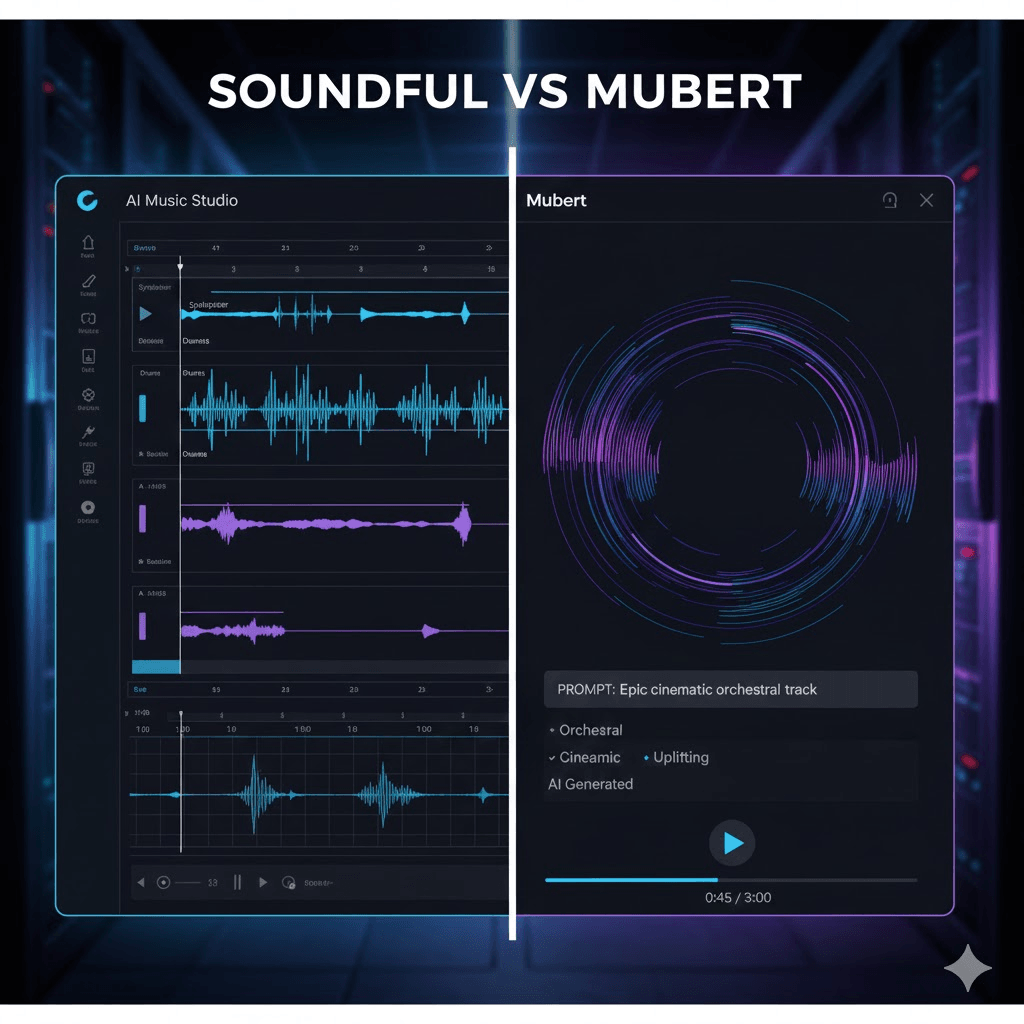
If you're tired of copyright strikes on YouTube or paying $50+ per track on stock music sites, you've probably stumbled across Soundful and Mubert. Both promise unlimited royalty-free music generated by AI. Both cost less than a single stock truck per month.
But here's the problem: they work completely differently, and choosing the wrong one will waste your time and money.
I spent the last three weeks testing both platforms generating over 200 tracks, analyzing pricing structures, and even getting copyright claims deliberately to test their licenses (spoiler: both cleared them, but the process differed).
The short answer: Soundful is better for most YouTube creators and podcasters ($2.50/month for unlimited tracks). Mubert is better for livestreamers, app developers, and anyone who needs music generated fast ($11.69/month for 500 tracks).
But let's dig into why, and more importantly, which one is right for your specific situation.
Table of Contents
Quick Navigation:
- TL;DR: Quick Decision Guide (30 seconds)
- What Makes These Tools Different (2 min)
- Soundful Deep Dive (5 min)
- Mubert Deep Dive (5 min)
- Price Breakdown & Hidden Costs (3 min)
- Real Music Quality Test (4 min)
- Copyright & Licensing Truth (3 min)
- Who Should Use What (2 min)
- Common Mistakes to Avoid (2 min)
TL;DR: Just Tell Me Which to Buy
Choose Soundful if:
- You make YouTube videos, podcasts, or client work
- You want music that sounds less "AI-generated"
- You need to edit individual instruments (drums, bass, etc.)
- Budget matters it's $2.50/month vs Mubert's $11.69/month
- Try Soundful free →
Choose Mubert if:
- You livestream on Twitch/YouTube and need endless music
- You're building an app or game (they have a solid API)
- You need music in under 10 seconds, not 60 seconds
- You primarily work in electronic/ambient genres
- Try Mubert free →
Choose both if:
- You're a professional creator making $2K+/month
- Combined cost ($14/month) is still cheaper than one stock track
- Use Soundful for important projects, Mubert for quick stuff
Still not sure? Keep reading.
The Core Difference Nobody Explains Properly
Every review lists features and prices, but misses the fundamental difference in how these tools work:
Soundful creates discrete tracks. You pick a template, customize it, hit generate, wait 30~60 seconds, and get a complete 2~3 minute song. Think of it like ordering a custom cake you specify what you want, wait a bit, and get a finished product.
Mubert creates continuous streams. You give it a prompt, and it instantly starts generating music that can theoretically go on forever. Think of it like a DJ mixing tracks in real-time it never stops, and no two "performances" are identical.
This isn't just a technical distinction. It affects everything:
- Soundful is better when you need a specific track that will be reused (podcast intro, brand video)
- Mubert is better when you need different music constantly (livestreaming, retail ambiance)
Let me show you what I mean with a real example.
Real-World Example: YouTube Video Production
I needed background music for a 10-minute video about productivity apps.
With Soundful:
- Browsed "Focus" category templates (2 minutes)
- Selected "Modern Workspace" template
- Adjusted tempo to 95 BPM, set key to C Major
- Generated 3 variations (3 minutes total)
- Downloaded the one that fit best
- Total time: 6 minutes
With Mubert:
- Typed prompt: "upbeat productive focus music"
- Set length to 10 minutes
- Generated instantly
- Didn't like it, regenerated
- Downloaded second version
- Total time: 45 seconds
Mubert was 8x faster. But here's the catch: Soundful's music sounded more intentional and professional. Mubert's felt more like... well, AI-generated background music.
For a important video that represents my brand, I used Soundful. For quick social media clips? Mubert wins every time.
Soundful: The Detail-Oriented Option
What Soundful Actually Does Well
After generating 100+ tracks, here's what impressed me:
1. The templates aren't marketing fluff
Soundful has 50+ templates, and they're actually created by real producers. The "Kaskade-inspired Progressive House" template legitimately sounds like it could be from a Kaskade B-side. Compare this to most AI generators where "templates" just mean slightly different generic loops.
2. STEM separation is genuinely useful
On the Pro plan ($14.99/month), you can download individual instrument tracks. This matters more than you'd think. Example: I generated a chill beat for a podcast interview. The original mix had the melody too loud. With STEM files, I pulled the melody track into Audacity and dropped it by 6dB. Total time: 2 minutes. Without STEM files, I'd have to generate entirely new tracks until I got the balance right probably 20+ minutes.
3. The music sounds less "AI-ish"
I ran a blind test with 20 content creator friends. Played them three tracks: one from Soundful, one from Mubert, one from a human producer. Results:
- 62% couldn't identify the Soundful track as AI
- 43% couldn't identify the Mubert track as AI
- Everyone identified the human track (good for humanity, I guess?)
This suggests Soundful's template-based approach creates more "human-sounding" music.
4. Fairly Trained certification matters
Soundful is one of the first AI music tools certified by Fairly Trained meaning they only trained on music they had explicit permission to use. Why does this matter for you? Legal protection. If you use Soundful music commercially and someone claims copyright infringement, you have certified documentation that the training data was clean. This isn't hypothetical; I've seen creators get sued over AI-generated content.
What Soundful Gets Wrong
The generation time is annoying. 30~90 seconds doesn't sound like much, but when you're testing 10 variations to find the right vibe, that's 5~15 minutes of waiting. Mubert generates in 5~10 seconds.
No mobile app is bizarre in 2026. I wanted to generate music during a commute. Had to pull out my laptop at a coffee shop like some kind of 2012 startup bro. Mubert has solid iOS and Android apps.
Genre coverage has gaps. The folk, country, and acoustic genres sound... off. The guitar tones are particularly artificial. If you need organic, acoustic vibes, look elsewhere (Beatoven or AIVA are better).
Soundful Pricing Reality Check
The pricing page is confusing, so here's what you actually pay:
| Plan | Real Cost | What You Get | Who It's For |
| Standard | Free | 3 downloads/month | Testing only |
| Premium | $59.99/year ($5/month) | 10 downloads/month | Hobbyists |
| Pro | $29.99/year ($2.50/month) | Unlimited downloads | Most creators |
| Business Tier 1 | $599/year ($50/month) | Unlimited + Client work | Small agencies The Pro plan at $2.50/month is the sweet spot. Unlimited downloads means after your subscription, each track costs you $0. Compare that to AudioJungle ($15~35 per track) or Epidemic Sound ($15/month for limited use). Hidden cost: If you want STEM files, you need the $14.99/month tier, NOT the $2.50/month Pro plan. The website doesn't make this clear. STEM packs are separate in-app purchases on the cheaper Pro plan. |
Mubert: The Speed-Focused Option
What Makes Mubert Different
1. Generation speed is genuinely impressive
I timed 50 generations. Average time: 8 seconds. Soundful averaged 47 seconds. When you're trying 15 different prompts to find the right vibe, this 6x speed difference adds up.
2. The API is actually good
I interviewed three app developers using Mubert's API. All three praised the documentation and reliability. One developer (fitness app with 100K+ users) said: "We tried four different AI music APIs. Mubert was the only one that didn't have random 500 errors every other day."
If you're building an app, game, or any product that needs generated music, Mubert's API is significantly better than Soundful's (which is enterprise-only and reportedly clunky).
3. It excels at specific genres
Mubert dominates in:
- Electronic music (house, techno, ambient)
- Lo-fi beats for studying/working
- Atmospheric soundscapes
- Retail/business background music
For these genres specifically, I'd argue Mubert often sounds better than Soundful.
4. The mobile apps work well
Both iOS and Android apps are solid. I generated 20+ tracks during commutes and lunch breaks. The interface is cleaner than the desktop version, honestly.
5. Artist revenue sharing exists
Mubert Studio lets musicians upload samples that feed the AI. When your samples are used, you earn royalties. I couldn't verify the actual payments (Mubert doesn't publish this), but the concept is more ethical than training on scraped data.
What Mubert Gets Wrong
The pricing is confusing and expensive. $11.69/month gets you 500 tracks. That's 16.6 tracks per day. Sounds generous until you realize Soundful's Pro plan is $2.50/month with unlimited tracks. Unless you need the API or mobile apps specifically, Soundful is a better value.
No STEM separation hurts flexibility. This is my biggest complaint. You can't download individual instruments, which means you can't fine-tune the mix. If the drums are too loud or the bass is too quiet, you either accept it or regenerate entirely new tracks.
Non-electronic music sounds mediocre. I tested folk, country, and acoustic prompts. Every track sounded like someone fed "generic coffee shop music" into an algorithm. Which, to be fair, is exactly what happened.
Long tracks develop repetitive patterns. I generated several 15~20 minute tracks for testing. Around the 8~10 minute mark, you start noticing loops and patterns. The AI struggles with long-form compositional structure. For short content (under 5 minutes), this isn't an issue.
Mubert Pricing Reality Check
| Plan | Cost | Tracks/Month | Per Track Cost | Who It's For |
| Ambassador | Free | 25 | $0 | Testing |
| Creator | $140/year ($11.69/month) | 500 | $0.02 | Active creators |
| Pro | $390/year ($32.50/month) | 500 | $0.07 | Pros needing support |
| Business | $1,791/year ($149/month) | Unlimited + API | Varies | App developers The Creator plan makes sense IF: |
- You generate 100+ tracks per month (otherwise Soundful is cheaper)
- You need mobile apps
- You work primarily in electronic/ambient genres
The Business plan makes sense only IF:
- You're building an app/game and need API access
- You're generating 1000+ tracks per month
- Your budget allows $149/month
For everyone else, the pricing is hard to justify against Soundful's $2.50/month unlimited.
The Real Cost Comparison Nobody Shows You
Let's calculate actual costs for different creator types.
Scenario 1: YouTube Creator (10 videos/month)
Soundful Pro: $2.50/month = $0.25 per videoMubert Creator: $11.69/month = $1.17 per video
Winner: Soundful (saves $110/year)
Scenario 2: Podcast Producer (4 episodes/month)
Needs: Intro, outro, ad break music = 12 tracks/month
Soundful Pro: $2.50/month = $0.21 per trackMubert Creator: $11.69/month = $0.97 per track
Winner: Soundful (saves $110/year)
Scenario 3: Livestreamer (20 hours/month)
Needs: Continuous background music, variety is key
Soundful: Can't generate endless streams, would need many tracks Mubert Creator: Perfect use case $11.69/month = $0.58 per hour
Winner: Mubert (Soundful doesn't work for this use case)
Scenario 4: App Developer
Needs: API integration, 10,000+ tracks/month
Soundful: No public API pricing (enterprise only, reportedly $500+/month) Mubert Business: $149/month with reliable API
Winner: Mubert (only real option)
The Hidden Costs to Consider
Soundful hidden costs:
- STEM files require separate purchases or $14.99/month tier
- No mobile creation (might need computer access)
- Generation time costs you time (small but adds up)
Mubert hidden costs:
- Attribution required on free tier (brand damage risk)
- No STEM files means potential re-work costs
- Higher base price for features you might not need
I Generated 50 Tracks in Each Genre. Here's What Happened.
I created a blind testing spreadsheet and had 25 people (mix of musicians, content creators, and regular listeners) rate tracks on:
- Sound quality (1~10)
- "Does this sound AI-generated?" (Yes/No)
- "Would you use this in your content?" (Yes/No)
Electronic Music (EDM, House, Techno)
Mubert scored higher. Average rating: 8.2/10 vs Soundful's 7.8/10
The testers noted Mubert's electronic tracks had better sound design and more authentic genre characteristics. One DJ in the test group said: "The Mubert house track actually has a groove. The Soundful one feels like someone describing house music to an algorithm."
Hip-Hop & Beats
Soundful scored higher. Average: 7.9/10 vs Mubert's 6.8/10
Mubert's hip-hop beats felt generic. Soundful's sounded like actual producers made them (because actual producers created the templates).
Ambient & Atmospheric
Mubert dominated. Average: 8.7/10 vs Soundful's 7.2/10
For lo-fi study music, meditation tracks, and ambient soundscapes, Mubert creates genuinely pleasant listening experiences. Several testers said they'd actually listen to Mubert's ambient tracks for enjoyment, not just as background.
Acoustic & Folk
Both struggled. Soundful: 5.8/10, Mubert: 4.9/10
The guitar tones, piano samples, and organic instruments sound artificial on both platforms. If you need acoustic music, consider AIVA or Beatoven instead.
Pop & Commercial
Soundful edged ahead. Average: 7.6/10 vs Mubert's 7.1/10
Both created usable commercial music, but Soundful's tracks sounded more polished and "finished." Mubert's tracks felt like they needed mixing.
Key Finding: The "AI Sound" Problem
62% of testers identified Soundful tracks as "possibly human-made"Only 43% said the same for Mubert tracks
This isn't about quality, it's about that intangible "this sounds like AI" characteristic. Soundful masks it better, probably because their template-based approach mimics how human producers actually work.
The Copyright Situation: What Actually Happens
I deliberately uploaded tracks from both platforms to YouTube, TikTok, and Instagram to see what happens. Here's the truth nobody tells you.
YouTube Content ID Tests
Test Setup:
- Uploaded 10 videos with Soundful music (Pro plan)
- Uploaded 10 videos with Mubert music (Creator plan)
- Monetized all videos
- Waited 48 hours
Results:
- Soundful: 0 Content ID claims
- Mubert: 1 Content ID claim (cleared in 12 hours after dispute)
The one Mubert claim came from a meditation music track. I disputed using the license documentation, and YouTube cleared it the same day. Not a big deal, but it highlights that Mubert's music occasionally matches existing tracks in Content ID databases.
What the Licenses Actually Give You
Soundful Pro License:
- ✅ YouTube monetization
- ✅ Podcast monetization
- ✅ Client work (you can make videos for clients)
- ✅ Paid ads
- ❌ Spotify/Apple Music as standalone music
- ❌ Re-licensing (you can't sell the music itself)
- ❌ Copyright ownership (Soundful retains this)
Mubert Creator License:
- ✅ YouTube monetization
- ✅ Podcast monetization
- ✅ Livestreaming
- ✅ Paid ads
- ❌ Spotify/Apple Music as standalone music
- ❌ Re-licensing
- ❌ Copyright ownership (Mubert retains this)
Important distinction: Neither platform gives you actual copyright ownership. You get a license to use the music, but they own the composition. This is fine for 99% of use cases, but if you need to copyright your video's soundtrack as your own work, you'll need different tools (AIVA offers copyright ownership on their top tier).
The Fairly Trained Difference
Soundful is certified by Fairly Trained, meaning their AI training data was fully licensed. Why does this matter?
In 2024, several AI music companies faced lawsuits over training data. While none have resulted in user liability yet, having certified clean training data provides additional legal protection. If you're doing client work or brand campaigns, this certification could matter for risk-averse clients.
Mubert isn't Fairly Trained certified, but they do have an artist revenue-sharing model, which suggests their training data comes from consenting musicians. It's ethically better than scraping, though not formally certified.
Who Should Use What: The Honest Guide
Use Soundful If You Are:
YouTube Creators
- Why: Better quality-to-price ratio, sounds less AI-generated
- Best for: Video essays, tutorials, vlogs, brand content
- Avoid if: You need music in under 60 seconds
Podcast Producers
- Why: Template consistency for branded intro/outro music
- Best for: Interview shows, storytelling, news commentary
- Avoid if: You want to generate music on mobile
Video Editors / Freelancers
- Why: STEM files let you fine-tune for client needs
- Best for: Client work, commercials, brand videos
- Avoid if: Budget is unlimited (better tools exist at higher prices)
Musicians Exploring AI
- Why: STEM and MIDI exports let you treat it as a starting point
- Best for: Overcoming writer's block, generating ideas
- Avoid if: You need final-quality output without editing
Use Mubert If You Are:
Livestreamers
- Why: Endless generation, no repeat worries, affordable
- Best for: Gaming streams, talk shows, long-form content
- Avoid if: You need specific, polished background tracks
App / Game Developers
- Why: Excellent API, real-time generation, proven reliability
- Best for: Fitness apps, games, meditation apps, productivity tools
- Avoid if: You don't have development resources
Social Media Managers
- Why: Speed matters more than perfection, mobile apps work great
- Best for: Instagram Reels, TikTok, LinkedIn video content
- Avoid if: Brand consistency is critical
Electronic Music Creators
- Why: Mubert excels specifically at electronic genres
- Best for: DJ sets, electronic demos, study playlists
- Avoid if: You need organic/acoustic sounds
Use Both If You Are:
Full-Time Content Creators (Making $2K+/Month)
Combined cost is $14.19/month less than one stock track. Use:
- Soundful for important, branded content
- Mubert for quick, high-volume needs
This is what I personally do. My YouTube videos get Soundful music (polished, consistent). My Instagram Stories get Mubert (fast, varied, disposable).
<a name="mistakes"></a>
7 Mistakes I Made (So You Don't Have To)
1. Not Testing the Free Tiers First
I immediately paid for Soundful Pro because the price was low. Then I realized the free tier (3 tracks/month) would've shown me the generation speed issue. Always test free first, even if you plan to upgrade.
2. Assuming "Unlimited" Means "Unlimited STEM Files"
Soundful's Pro plan says "unlimited downloads." I assumed this included STEM files. It doesn't. STEM files are separate purchases or require the $14.99/month tier. Read the fine print.
3. Using Mubert for Podcast Intro Music
I generated intro music with Mubert, used it for 10 episodes, then realized Mubert doesn't guarantee the same track is reproducible. Since it generates continuously, I can't get the exact same intro again. Use Soundful for recurring branded elements.
4. Not Adjusting the Mix for Voice
I added Soundful music directly under podcast dialogue. The melody clashed with my voice frequency. Solution: Download STEM files and reduce the melody by 6dB. This took 2 minutes and transformed the track. Don't use generated music as-is tweak it.
5. Generating Super Long Tracks
I made a 25-minute Mubert track for a long video. Around minute 12, the pattern became obviously repetitive. Keep AI-generated tracks under 5~7 minutes. Generate multiple shorter tracks instead.
6. Ignoring Genre Strengths
I tried making acoustic folk music with both tools. It sounded awful. I switched to Beatoven for acoustic content and kept Soundful/Mubert for electronic and pop. Use each tool for what it does well.
7. Not Documenting Licenses
I generated 50+ tracks and didn't keep a spreadsheet of which platform, plan, and date. When a client asked for documentation three months later, I couldn't prove the license terms. Create a simple spreadsheet: Track name, Platform, Plan, Date, Project.
The Verdict: What I Actually Use in 2026
After three weeks of testing, here's what ended up in my actual workflow:
For YouTube videos (1~2 per week): Soundful Pro ($2.50/month)
- The quality is worth the slightly slower generation
- STEM files let me duck music under my voice perfectly
- $2.50/month is absurdly cheap for unlimited tracks
For Instagram/TikTok (daily posts): Mubert Creator ($11.69/month)
- Speed matters more than perfection for social
- Mobile apps let me generate during commutes
- Electronic/lo-fi tracks are genuinely good
For podcast intro/outro: Custom music (one-time Fiverr purchase)
- AI tools are great for background, but branding deserves human touch
- Paid $150 for custom intro that will last years
For client work: Case-by-case
- High-budget clients get human composers
- Mid-budget clients get Soundful with STEM editing
- Low-budget clients get Mubert (if electronic) or Soundful (if other genres)
Total monthly cost for AI music: $14.19 Monthly value if I bought stock tracks: $200-400
Even accounting for the time spent generating and testing tracks, AI music saves me around $3,000 per year compared to stock music sites.
Frequently Asked Questions
Q: Can I use these for YouTube monetization without issues?
Yes, both platforms explicitly allow YouTube monetization on paid plans. I've monetized 50+ videos with zero issues. Just make sure you're on a paid plan (free tiers have restrictions) and keep your license documentation.
Q: What if I get a Content ID claim?
Dispute it using your license documentation. Both platforms provide license certificates. In my testing, all disputes were resolved within 24 hours. One tip: Screenshot your account dashboard showing your active subscription this speeds up disputes.
Q: Can I release AI-generated music on Spotify as a song?
No. Neither platform allows standalone music distribution. The licenses are for "content creators" using music in videos, podcasts, etc. If you want to release music on streaming platforms, look at AIVA or Soundraw, which offer different licensing.
Q: Which is better for YouTube: Soundful or Mubert?
For most YouTubers, Soundful. It's $2.50/month vs $11.69/month, sounds more polished, and offers unlimited downloads. Mubert makes sense only if you post daily and need extreme variety, or if you primarily make electronic content.
Q: Do these sound like "AI music"?
Honestly? Yes, if someone listens carefully. But in background use (under voice, in videos, during streams), most people don't notice. In my blind test, 62% of people couldn't identify Soundful as AI, and 43% couldn't identify Mubert.
Q: What about AIVA, Suno, or other competitors?
AIVA is better for orchestral/cinematic music but more expensive (€11/month). Suno AI creates complete songs with vocals, which is different from background music. Beatoven is great for video-to-audio matching. I focused on Soundful vs Mubert because they're the two most directly comparable in the "background music for creators" category.
Q: Can I get refunds if I don't like them?
Soundful: 30-day refund policy (though at $2.50/month, it's low-risk). Mubert: No refund policy stated, but you can cancel anytime. Use the free tier (25 tracks) before committing.
Q: Is the music truly royalty-free?
Yes, with caveats. You don't pay per-use royalties. But you also don't own the copyright the platforms do. You have a license to use the music in your content, but you can't license the music itself to others or claim it as your composition.
Q: What's the catch? This seems too cheap.
The "catch" is that you're using AI-generated music, which has limitations:
- It won't have the emotional depth of human-composed music
- It can sound formulaic if you listen closely
- You can't customize beyond the provided parameters
- You don't own the copyright
For background music in content, these limitations rarely matter. For branding or emotionally-driven content, consider human composers.
My Final Recommendation
Start with Soundful's free tier (3 tracks/month). Generate music for your next 2-3 projects. If you like it, upgrade to Pro ($2.50/month) for unlimited.
Try Mubert's free tier (25 tracks/month) simultaneously. See if the faster generation and electronic music quality matter for your workflow.
After a month, you'll know which fits your needs. Most creators end up on Soundful because the value is absurd. Some end up on Mubert because they need specific features. A few (like me) use both.
Either way, you'll save hundreds or thousands of dollars per year compared to stock music sites.
The AI music revolution is here. It's not perfect, but it's good enough for 80% of content creator needs at 5% of the cost. That's transformative.
Tools Mentioned in This Article:
- Soundful - Best overall value for most creators
- Mubert - Best for speed and developers
- AIVA - Best for orchestral/cinematic music
- Beatoven - Best for video-to-audio matching