Beethoven vs Vivaldi: Which Composer Should You Know?
Updated: 2026-01-09 10:07:48
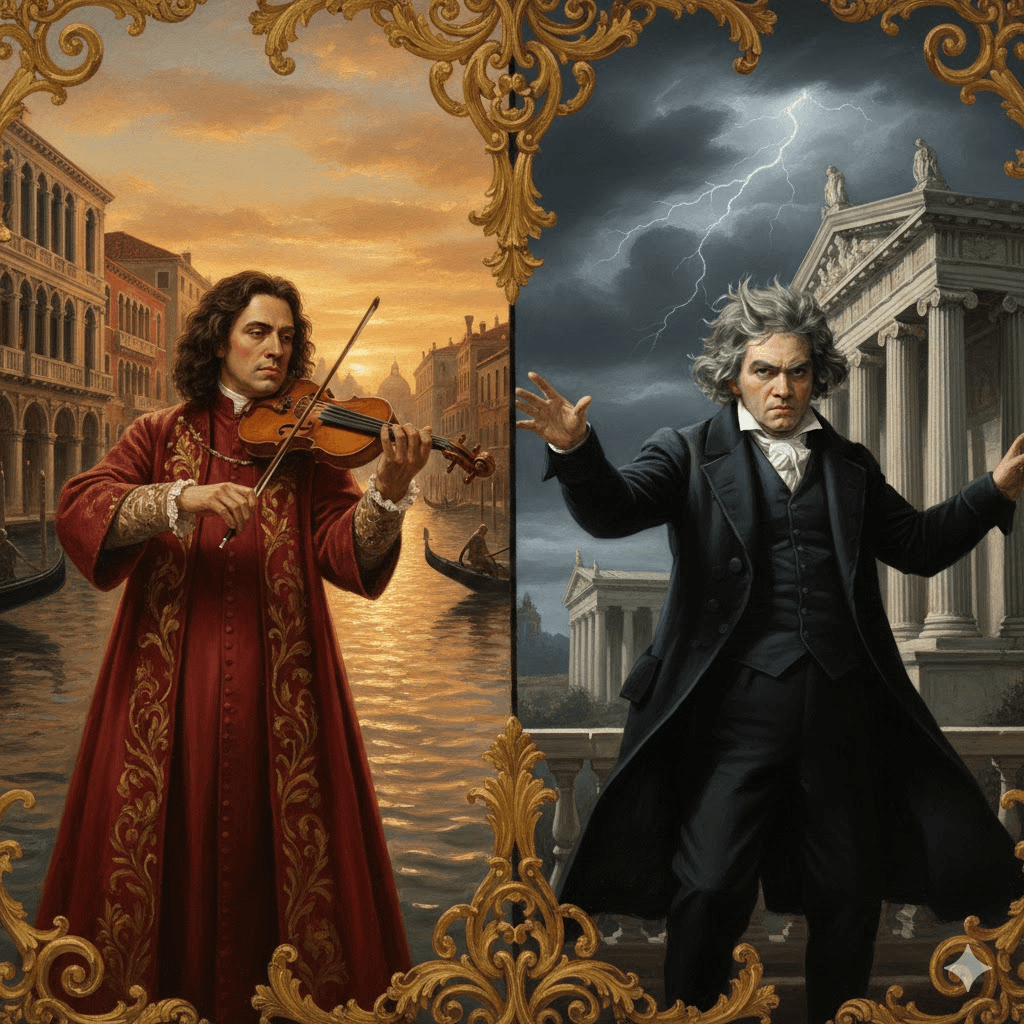
When people ask me about Beethoven vs Vivaldi, I usually start by pointing out they're separated by almost a century and an entire shift in how Western music worked. Antonio Vivaldi died in 1741, when Ludwig van Beethoven's grandfather was barely a teenager.
That might sound like a strange comparison at first. But here's why it matters: these two composers represent fundamentally different approaches to making music, yet both shaped how we think about classical music today. Vivaldi perfected the baroque concerto. Beethoven essentially invented what we mean by "artistic genius" in music.
In this guide, I'll walk you through both composers their lives, their music, what makes them different, and why both deserve your attention. Whether you're studying for a music exam, planning your next concert hall visit, or just curious, you'll find what you need here.
Table of Contents
- Historical Context: Different Eras, Different Rules
- Antonio Vivaldi: The Red Priest of Venice
- Ludwig van Beethoven: The Revolutionary
- Musical Style: What Actually Makes Them Different
- How They Actually Wrote Music
- Essential Works to Listen To
- Their Impact on Music History
- For Musicians: What It's Like to Perform Their Works
- Frequently Asked Questions
- Final Thoughts
Historical Context: Different Eras, Different Rules
Before diving into the composers themselves, let's get our bearings on when and where they lived. This context matters more than you might think.
Antonio Vivaldi (1678~1741): The Red Priest of Venice
Baroque Period | 1678~1741
Vivaldi was born in Venice right when the baroque style was hitting its stride. His father was a violinist at St. Mark's Basilica, which meant young Antonio grew up surrounded by music. The baroque era loved complexity think intricate counterpoint, continuous bass lines, and lots of ornamentation.
Venice in the late 1600s was something special. It was one of Europe's wealthiest cities, a trading hub where East met West. Music was everywhere in churches, opera houses, and private salons. The city supported dozens of composers, but Vivaldi stood out.
He got ordained as a priest in 1703 (hence "The Red Priest" a reference to his red hair), but supposedly stopped saying Mass within a year because of his asthma. Or maybe he just preferred composing. Either way, he spent most of his career at the Ospedale della Pietà, an orphanage and music school for girls.
A note about the Pietà: This wasn't just any orphanage. The Pietà was famous throughout Europe for its all-female orchestra and choir. Vivaldi composed hundreds of pieces specifically for these young musicians which tells you something about both his teaching skills and his productivity. The concerts attracted tourists from across Europe, kind of like a baroque-era tourist attraction
Vivaldi was incredibly prolific. We're talking over 500 concertos, 46 operas (though most are lost), and numerous sacred works. He wrote fast, and he wrote a lot. Some critics later accused him of "writing the same concerto 500 times," which isn't really fair, but it does capture something about his style once he found formulas that worked, he used them.
Ludwig van Beethoven (1770~1827): The Revolutionary
Classical Period | Early Romantic Period | 1770~1827
Beethoven came along nearly 30 years after Vivaldi died. He was born in Bonn, Germany, into a family of musicians. His father was a court musician and, unfortunately, an alcoholic who pushed young Ludwig brutally to become a child prodigy (it worked, but at considerable personal cost).
By the time Beethoven was making his mark in Vienna, the whole world had changed. The French Revolution happened. Napoleon rose and fell. The Enlightenment had shifted how people thought about individual rights, reason, and personal expression. All of this seeped into the music.
The classical period (roughly 1750~1820) reacted against baroque complexity. Composers wanted clarity, balance, natural expression. Think of it as baroque maximalism giving way to classical elegance. Haydn and Mozart perfected this style. Then Beethoven showed up and bent all the rules.
About Beethoven's deafness: This is the part everyone knows Beethoven went deaf. But here's what often gets missed: he started losing his hearing in his late twenties, when he was just establishing himself. By his early thirties, he was seriously considering suicide (we know this from the "Heiligenstadt Testament," a letter he wrote to his brothers but never sent). He decided to live for his art instead. By his mid-forties, he was completely deaf. Yet some of his greatest works the Ninth Symphony, the late string quartets came from this period when he couldn't hear a note
Beethoven was also one of the first composers to achieve real financial independence. He didn't rely entirely on aristocratic patrons or church positions. He sold his works to publishers, charged for concerts, and basically treated himself as an independent artist which was pretty revolutionary for the time.
Musical Style: What Actually Makes Them Different
Okay, enough history. Let's talk about what you actually hear when you listen to these composers.
| Element | Vivaldi | Beethoven |
| Texture | Polyphonic multiple melodies weaving together with a continuous bass line (basso continuo) | Mostly homophonic one clear melody with accompaniment underneath, though he uses counterpoint when he wants to |
| Structure | Ritornello form, three-movement concertos (fast-slow-fast) | Sonata-allegro form, expanded symphonies, theme and variations |
| Rhythm | Continuous rhythmic drive once it starts, it keeps going | Dramatic contrasts fast to slow, sudden stops, surprising accents |
| Melody | Long, virtuosic lines with lots of ornamentation and sequential patterns | Short, punchy motifs that he develops and transforms throughout the piece |
| Harmony | Functional but straightforward he's not trying to surprise you harmonically | Adventurous unexpected key changes, lots of tension and resolution |
| Dynamics | Terraced (sudden shifts from loud to soft) | Gradual crescendos and diminuendos, extreme contrasts (whisper to thunder) |
| Instruments | Small baroque orchestra, harpsichord continuo, featured violin | Larger classical orchestra, added winds and brass, featured piano |
| Emotion | One mood per movement elegant, restrained, focused on technical display | Emotional rollercoaster struggle, joy, despair, triumph, sometimes all in one movement Personal note: I remember the first time I really noticed this difference. I was listening to Vivaldi's "Winter" from the Four Seasons back-to-back with Beethoven's Fifth Symphony. Vivaldi gave me this sense of "here's a vivid picture in sound." Beethoven gave me "here's a philosophical argument in sound." Both work, but they're trying to do different things. |
How They Actually Wrote Music
Vivaldi's Approach: Get to the Point
Vivaldi was all about momentum and clarity. His concertos follow predictable patterns, but that's actually part of their appeal. You always know where you are in the musical structure.
Here's his typical approach:
- Ritornello form: The full orchestra plays a recurring theme (the ritornello), alternating with solo sections. It's like a refrain in a song it keeps coming back to anchor you.
- Programmatic writing: The Four Seasons is the famous example. Each concerto comes with a sonnet describing what's happening storms, birds, sleeping shepherds. Vivaldi translates these images into specific musical gestures.
- Sequences: He takes a short melodic pattern and repeats it at different pitch levels. This creates forward momentum without having to invent new material constantly.
- Harmonic clarity: Straightforward progressions that support rather than obscure the melodic line.
- Idiomatic writing: He wrote for the violin the way violinists actually want to play exploiting the instrument's natural resonances and technical possibilities.
Vivaldi's music is often described as "easy to learn but delightful to perform." That's not an insult it means he understood his audience (both players and listeners) and gave them what worked.
Beethoven's Approach: Take Something Small and Make It Huge
Beethoven worked completely differently. He was obsessed with development taking tiny musical ideas and transforming them in every possible way.
- Motivic development: The opening of the Fifth Symphony is four notes short-short-short-long. Beethoven then spends 30+ minutes exploring every possible variation of that rhythm. It shows up in different keys, speeds, instruments, contexts. This is development taken to an extreme.
- Expanded forms: Beethoven inherited sonata-allegro form from Haydn and Mozart, then stretched it. His development sections are longer, more adventurous. He messes with your expectations.
- Dramatic key relationships: He'll modulate to distant keys just for the psychological impact. The shock of suddenly landing in an unexpected harmonic area creates drama.
- Rhythmic innovation: Unexpected accents, hemiolas (playing groups of 2 against groups of 3), rhythmic displacement anything to keep you off balance.
- Thematic transformation: A theme that sounds heroic in one section might return tender and vulnerable in another. It's the same material, but completely reimagined.
- Organic unity: Creating cyclic relationships where themes from early movements return transformed in later ones.
"Beethoven's music makes you work. Vivaldi's music invites you in. Neither approach is better they serve different purposes. Sometimes I want to be challenged and shaken. Other times I want beauty and craft without the emotional heavy lifting.
Essential Works: Where to Start Listening
Let's get practical. If you're going to dive into either composer, here's where I'd start.
Essential Vivaldi
- The Four Seasons, Op. 8, Nos. 1~4 (1725)
Start here. Everyone knows "Spring," but listen to all four. Pay attention to how Vivaldi uses musical gestures to paint pictures the string tremolos for ice in "Winter," the staccato notes for barking dogs in "Spring."
🎵 Listen: Search YouTube for "Vivaldi Four Seasons Fabio Biondi" or check Spotify for historical performance recordings.
What to notice: How does Vivaldi balance solo violin virtuosity with the orchestral backdrop? Can you tell when the ritornello (main theme) returns?
- L'estro Armonico, Op. 3 (1711)
This collection of 12 concertos made Vivaldi famous across Europe. J.S. Bach was so impressed he transcribed several for organ and harpsichord. Start with Concerto No. 6 in A minor.
What to notice: The interplay between solo and tutti (full orchestra) sections. Vivaldi's control of musical conversation.
- Gloria in D Major, RV 589
Want to hear Vivaldi write for voices? This is your ticket. It's joyful, accessible, and shows he could do more than just concertos.
What to notice: How he balances choral and solo vocal sections. The energy and forward momentum even in slower movements.
Essential Beethoven
- Symphony No. 5 in C minor, Op. 67 (1808)
The most famous opening in classical music. But don't stop at the first movement the whole symphony is a journey from darkness to light.
🎵 Listen: Try Carlos Kleiber's recording with the Vienna Philharmonic, or for something more recent, the Simon Rattle version with the Berlin Phil.
What to notice: Track that four-note "fate" motif through all four movements. It's almost always there in some form.
- Piano Sonata No. 14 "Moonlight," Op. 27, No. 2 (1801)
Despite the romantic nickname (which Beethoven never used), this piece showcases his innovative approach. He puts the slow movement first, breaking convention.
What to notice: The continuous triplet arpeggio in the first movement creates an atmosphere rather than a traditional melody. The third movement's fury shows the other side of Beethoven's emotional range.
- Symphony No. 9 "Choral," Op. 125 (1824)
Beethoven's last completed symphony. He adds vocal soloists and chorus in the finale, setting Schiller's "Ode to Joy" to music. This was unprecedented.
🎵 Listen: Leonard Bernstein's 1989 Berlin Wall performance is historically significant, or try the Karajan/Berlin Phil recording from the 1960s.
What to notice: The finale alone is longer than many complete symphonies. Pay attention to how Beethoven cycles through and rejects themes from earlier movements before landing on the "Ode to Joy."
- String Quartet No. 14 in C-sharp minor, Op. 131 (1826)
Written when Beethoven was completely deaf. Seven movements played without pause. This is Beethoven at his most experimental and profound. It's not easy listening, but it's worth the effort.
What to notice: How the movements flow into each other. The fugue in the first movement. The sheer ambition of the structure.
Their Impact: Who Matters More?
This is the part where people usually want me to pick a winner. I'm going to disappoint you.
Vivaldi's Influence
Here's the thing about Vivaldi his influence was enormous during his lifetime, then basically disappeared for 180 years. After he died in 1741, his music fell out of fashion. The classical era wanted something different. His scores sat in archives, unknown and unperformed.
Then in the 1920s and '30s, musicologists started rediscovering massive collections of his manuscripts. The Four Seasons was revived. Suddenly everyone realized what they'd been missing.
His lasting contributions:
- Established the three-movement concerto as the standard form
- Influenced J.S. Bach's concerto writing (which is saying something)
- Created the template for the solo concerto that Mozart and others built on
- Showed how music could be programmatic telling stories and painting pictures
Today, the Four Seasons is one of the most recorded pieces of classical music. His violin concertos are standard repertoire. He appears in countless commercials, movies, and TV shows. Not bad for someone who was forgotten for two centuries.
Beethoven's Influence
Beethoven's influence never waned. From his death in 1827 to today, he's been continuously performed, studied, and revered.
He changed what music could do. Before Beethoven, composers were basically craftsmen skilled, respected, but ultimately servants to patrons. Beethoven helped establish the composer as an independent artist with something important to say.
His impact includes:
- Inspired the entire Romantic movement Schubert, Brahms, Wagner all worked in his shadow
- Expanded what orchestras could do and how big they could get
- Demonstrated that music could grapple with philosophical ideas, not just entertain
- His symphonies became THE standard every subsequent composer had to reckon with them
- The "suffering artist" archetype partly comes from Beethoven's story
Something often overlooked: Beethoven never heard Vivaldi. When Beethoven was composing, Vivaldi's music had completely disappeared from concert life. But Vivaldi's influence reached Beethoven through Bach, whose works Beethoven knew well. So there's an indirect connection Vivaldi influenced Bach, Bach influenced Beethoven. Music history is more connected than it seems
The "Ode to Joy" from Beethoven's Ninth has become a symbol of human unity. The European Union uses it as their anthem. It was played when the Berlin Wall came down. That level of cultural penetration is rare.
For Musicians: What It's Like to Perform Their Works
If you're a musician, you already know this. If you're not, here's what it's like to actually play this music.
Performing Vivaldi
Vivaldi wrote for performers. His music lies well on the instruments which makes sense, given that he was a violinist himself and worked with student musicians.
For string players: His violin writing is brilliant. Technically demanding, sure lots of fast passage work, high positions, string crossings but it follows logical patterns. The music "makes sense" under your fingers. You're not fighting the instrument.
I once had a teacher who said, "Vivaldi is hard in the way that a really good workout is hard it challenges you, but you feel good doing it." That's accurate. The difficulty serves a musical purpose.
For ensembles: Vivaldi's music works well with smaller baroque orchestras. The basso continuo (continuous bass) provides a solid foundation. Individual parts are clear and well-defined. Amateur groups can tackle Vivaldi and sound good.
Performing Beethoven
Beethoven is different. He's not writing to make your life easy he's writing what the music needs.
For pianists: Beethoven's piano music is brutally difficult. He was constantly pushing piano makers to build stronger, more resonant instruments. His sonatas require enormous technical facility thick chords, rapid passage work, extreme dynamic contrasts.
But the real challenge is interpretive. How do you balance the intellectual structure with the emotional content? How much rubato (expressive tempo flexibility) is too much? These aren't easy questions.
For orchestras: Beethoven requires precision and stamina. His symphonies are long. The dynamic contrasts are extreme you need to be able to play whisper-soft and then blast immediately. The rhythmic complexity demands absolute ensemble coordination.
His late string quartets are considered some of the hardest chamber music ever written. Not just technically (though they are), but interpretively. What is Beethoven trying to say here? Musicians and scholars still debate this.
Frequently Asked Questions
Was Beethoven influenced by Vivaldi?
Not directly Vivaldi's music had fallen into obscurity by Beethoven's time, and there's no evidence Beethoven ever heard a Vivaldi piece. However, Vivaldi's influence reached Beethoven indirectly through J.S. Bach. Beethoven studied Bach's works extensively (he could play all of the Well-Tempered Clavier from memory), and Bach had absorbed Vivaldi's structural innovations, particularly in concerto form. So there's a chain: Vivaldi → Bach → Beethoven.
Why is Beethoven more famous than Vivaldi?
Several reasons. First, timing Beethoven's music never went out of fashion, while Vivaldi's was forgotten for almost two centuries after his death. Second, Beethoven's music resonates with modern sensibilities about individual expression and emotional authenticity. His story the deaf composer creating masterpieces became a powerful cultural narrative. Third, the 19th century actively promoted Beethoven as the ideal of artistic genius, which shaped his reputation.
That said, Vivaldi has had an enormous revival since the 1950s. The Four Seasons is now one of the most recognized pieces of classical music worldwide. He's not obscure anymore just serving a different role in the cultural imagination.
What's the main difference between baroque and classical music?
Baroque music (roughly 1600~1750, Vivaldi's era) is characterized by continuous melodic lines, ornamental complexity, polyphonic texture, and basso continuo (continuous bass line). Think elaborate decoration, intricate patterns, multiple melodies happening simultaneously.
Classical music (roughly 1750~1820, Beethoven's early era) shifted toward clarity and balance. Homophonic texture (one melody with accompaniment), periodic phrasing (balanced musical sentences), clearer structural forms. Less decoration, more emphasis on form and proportion.
The easiest way to hear this: baroque music sounds more continuously flowing, classical music sounds more sectional and balanced.
Which composer should I listen to first?
Honestly? Start with Vivaldi's Four Seasons. It's accessible, programmatic (it tells stories), and relatively short. You don't need any musical training to enjoy it.
Once you're comfortable with that, try Beethoven's Fifth Symphony. It's iconic for a reason the structure is clear, the emotional arc is powerful, and it's not too long.
Both are entry points into their respective composers' wider catalogs.
Did Beethoven write concertos like Vivaldi?
Yes Beethoven composed five piano concertos, one violin concerto, and a triple concerto for piano, violin, and cello. But his approach differs significantly from Vivaldi's. Beethoven's concertos are more symphonic the solo and orchestra are more integrated, sharing material and engaging in dialogue rather than alternating. He uses sonata-allegro form rather than ritornello structure. And his concertos are much longer, with extended development sections and often lengthy cadenzas for the soloist.
Final Thoughts: What These Composers Actually Teach Us
After spending time with both Beethoven and Vivaldi listening, studying, writing about them I've come to see them as representing two necessary extremes in music making.
Vivaldi shows you that clarity and craft matter. His music proves you don't need to be complicated to be profound. The Four Seasons has lasted 300 years not because it's intellectually challenging, but because it does what it sets out to do with complete mastery. There's a lesson there about knowing your audience and delivering excellence within clear constraints.
Beethoven shows you that music can change how people think and feel. His works demonstrate that technical innovation serves emotional truth. When you listen to the Ninth Symphony, you're not just hearing beautiful sounds you're experiencing an argument about human brotherhood, freedom, and joy. Music as philosophy.
Both approaches matter. Sometimes I need Vivaldi's clarity and energy. Other times I need Beethoven's depth and struggle. The best musical education includes both.
Your Next Steps
If this guide sparked your interest, here's what I'd recommend:
- Listen to the Four Seasons while reading along with the sonnets (they're easy to find online)
- Watch a live performance of Beethoven's Fifth if you can the experience is different in person
- Explore the composers between them particularly Haydn and Mozart to understand how baroque became classical
- If you're a musician, try performing works by both to understand the different technical and interpretive challenges
- Read Beethoven's Heiligenstadt Testament it's a powerful document that helps you understand his mindset